Below, we describe the Diospyros lotus, also known as the lotus tree or the god's pear.
Diospyros lotus is dioecious: each tree is either female or male. Female trees bloom in June and/or July with very small flowers that grow in clusters of 2–3; these are pinkish-white in color. The relatively large calyx is a striking feature during flowering. The male flowers are brown in color.
The fruits that grow on the female Dyospyros lotus plants are small, round, and shiny. These yellow lotus fruits, also known as date plums, are edible for those who enjoy them. They have a sweet flavor but, unfortunately, do not keep for very long. In October and November, the fruits ripen to a blue-black color.
The leaves are attached to a short petiole; they are oval, pointed, and have smooth margins. The leaves are dark green, glossy on top, and hairy on the underside. The golden-yellow autumn coloration of Diospyros lotus adds to the tree’s ornamental value in the fall.
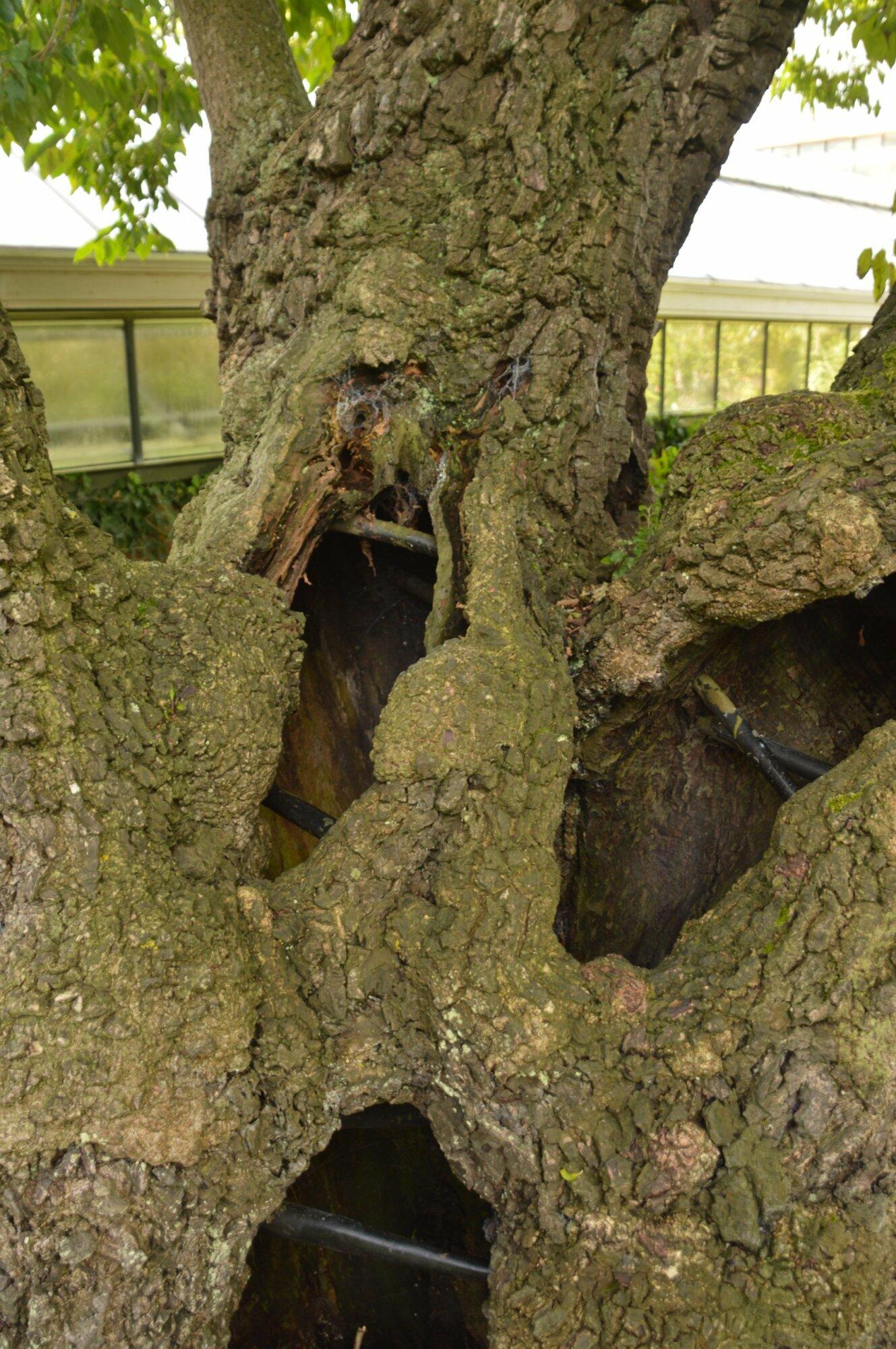
We currently grow Diosporys lotus as a female tree and a multi-stemmed shrub at our tree nursery. The tree is well-suited for planting in parks, gardens, or green belts. The tree generally grows well in the Netherlands but can be somewhat sensitive to frost. It will likely thrive best in a somewhat sheltered location. In our climate, the tree often does not grow taller than 6 to 9 meters; in a warmer climate, it can reach heights of 15 to 25 meters. A striking feature of Diospyros lotus is the deeply furrowed bark that develops as the tree ages.
Photo locations: Hortus Leiden and our nursery
‘The Leiden Botanical Garden is home to a very old male specimen of Diospyros lotus that was planted in 1740; it is one of the oldest trees in the garden. Because it is a male specimen, this monumental tree never bears fruit. Since 2002, a young female specimen has been growing in the ‘Fern Garden’ of the Leiden Botanical Garden, and it bears fruit every year. A striking characteristic of Diospyros lotus is the deeply furrowed bark that the tree develops as it ages.’.