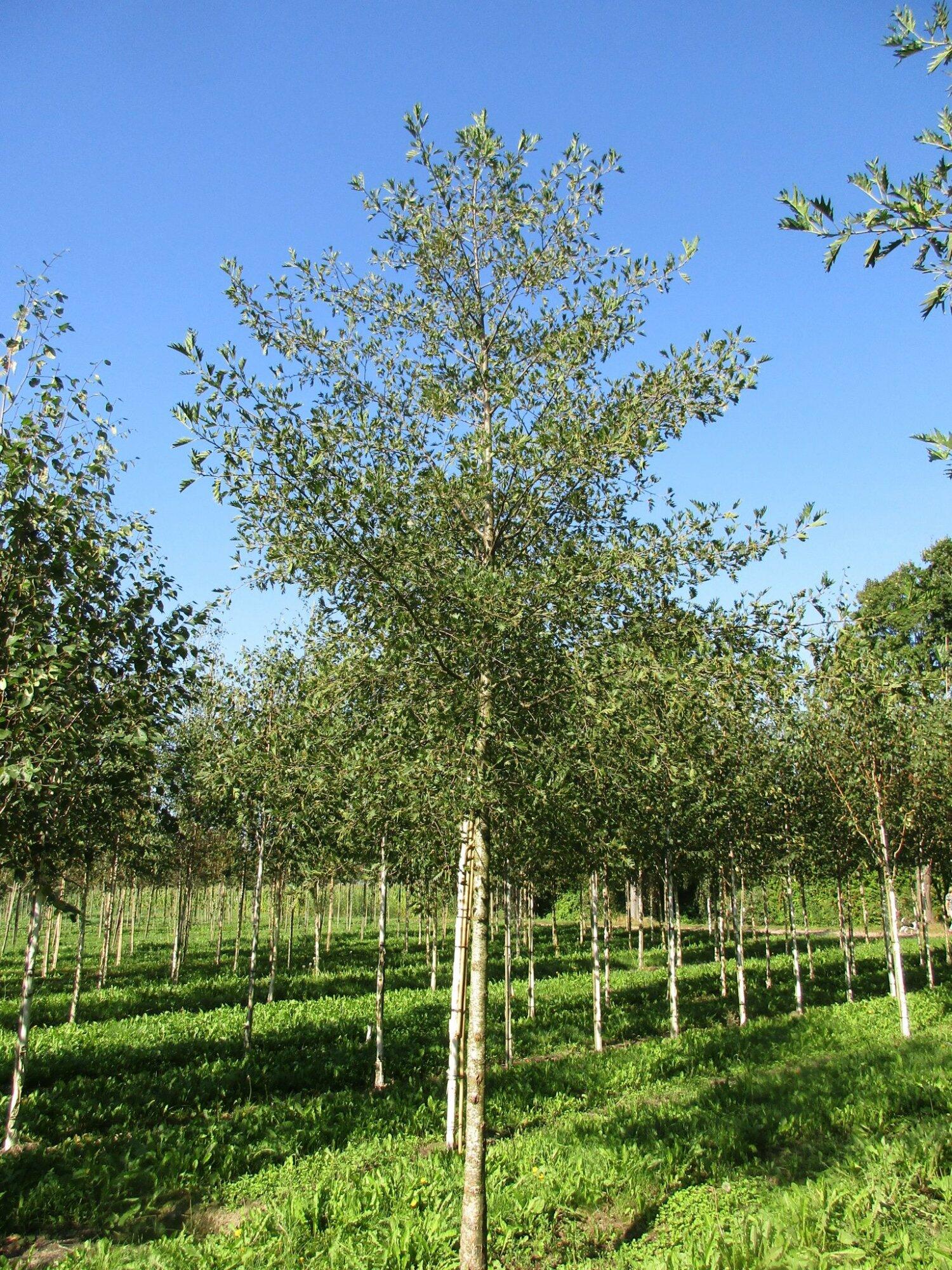
Alnus glutinosa ‘Laciniata’ develops a broad, conical crown, reaching a final height of 8 to 12 meters. A striking feature is its open and sometimes somewhat irregular crown shape.
This tree is well-suited for planting in green belts, parks, or on business properties. It also thrives in coastal areas. However, it is not suitable for narrower streets.
A striking feature is its deeply lobed, lance-shaped leaves. This makes the tree easily recognizable, and the cultivar name ‘Laciniata’ (lance-shaped) is based on this characteristic. In early spring, male flowers appear at the base of the leaves in the form of striking, brownish-yellow, elongated catkins. The characteristic alder cones appear starting in September and remain on the tree for a long time; these are the fruits of the female flowers.
The stalked buds and young leaves of Alnus glutinosa feel sticky; the word ‘glutinosa’ refers to this characteristic.
Alnus glutinosa ‘Laciniata’ was discovered in 1819 in a garden located in the Saint-Germain-des-Prés neighborhood of Paris.
Location of photos: Haaren, Almere (Floriade), Leidsche Rijn (Utrecht), and our nursery