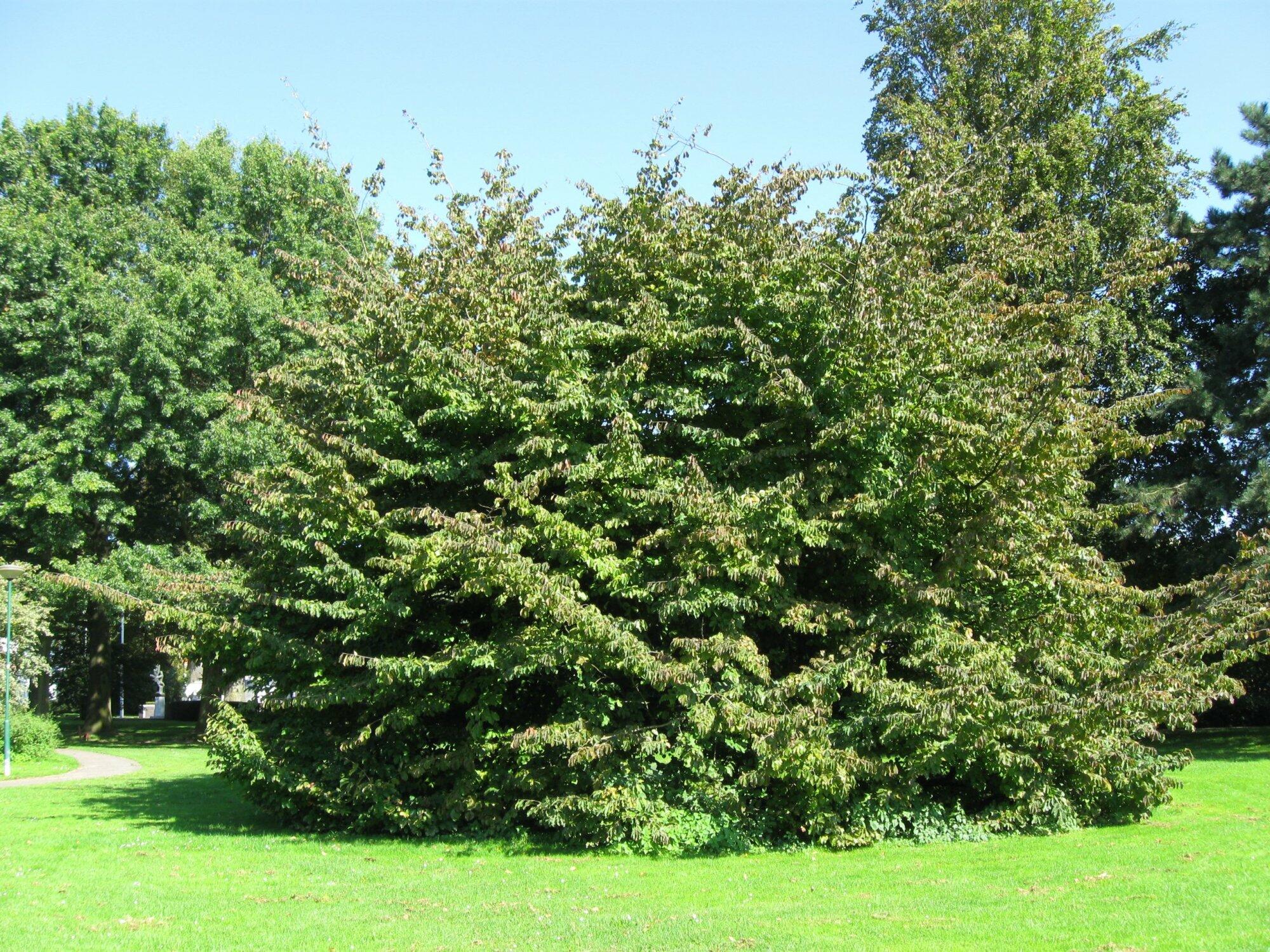
We’ll focus on Parrotia persica, Persian ironwood. This species often grows in a shrub-like manner, spreading widely with an irregular branch structure. If you leave the shrub untended, it will eventually become very wide. Parrotia is naturally very hardy and has minimal soil requirements.
We frequently grow Parrotia persica as a multi-stemmed shrub at our nursery. Because of its ornamental value, this shrub is being planted more and more often in gardens and parks. The shrub tolerates pruning well, which allows you to maintain it as a specimen plant in the desired shape.
Its greatest ornamental value likely lies in its glossy dark green leaves, which often have reddish edges. Over the course of summer and into fall, the leaves develop beautiful shades of yellow, orange, red, and/or purple. Another striking feature is the bark, which has a grayish-green color and peels off in flakes, much like that of a sycamore; this is particularly noticeable on older trees. The somewhat inconspicuous flowering begins as early as February–March, before the leaves emerge. Most noticeable are the red anthers on the stamens.
Parrotia persica is native to an area south of the Caucasus Mountains in the border regions of Iraq, Armenia, Azerbaijan, and Iran. The wood of the Parrotia is very hard, which is why the tree is called ‘Persian Ironwood’ in England, ‘Eisenholzbaum’ in Germany, and ‘Perzisch ijzerhout’ in the Netherlands.
Location of photos: Haaren, Oisterwijk, The Hague, and our nursery.