

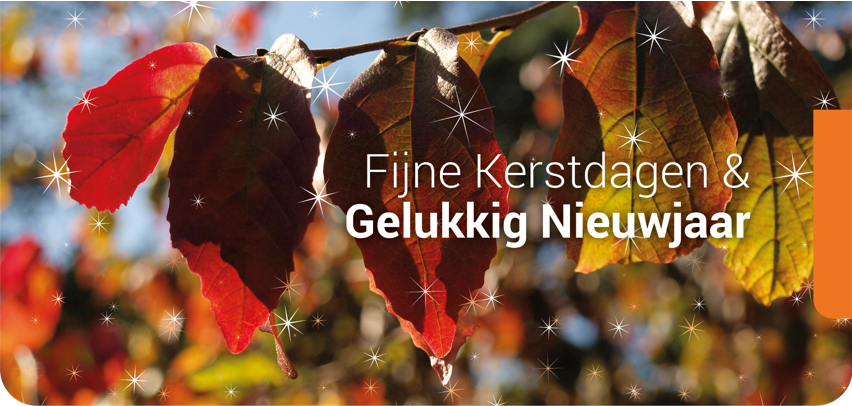
Parrotia persica is a versatile tree that offers ornamental value in every season. That is why we would like to highlight it here in our Christmas message.
Species with ornamental value
The spectacular fall colors and the peeling bark are the main ornamental features of Parrotia persica. In the summer, the tree has glossy dark green leaves, often with reddish edges. In the fall, the leaves take on shades of yellow, orange, red, and/or purple. The bark is a grayish-green color that peels, much like that of a sycamore; this is particularly noticeable on older trees. Parrotia blooms strikingly from January through March, with red anthers on the stamens. The fruit is a horned capsule about 1 cm in size, but fruiting is less common in our climate. The wood is very hard, which is why the tree is also known as ‘Persian ironwood’ in the Netherlands, ‘Persian Ironwood’ in England, and ‘Eisenholzbaum’ in Germany.
Application
Parrotia persica is ideal for planting in parks and along green belts. The trees generally grow in a shrub-like manner, spreading widely with an irregular branch structure. The tree can eventually reach a height of 8 to 10 meters, but its growth is relatively slow. We grow Parrotia persica Both as a tree and as a multi-stemmed shrub at our nursery.
Origin
This tree species is native to an area south of the Caucasus, in the border regions of Iraq, Armenia, Azerbaijan, and Iran. Large specimens of Parrotia persica They are found mainly in higher-altitude areas where the climate is humid and cool. There, the tree can grow as tall as 20 to 25 meters and bears fruit much more frequently.
Business Closure
We will be closed from December 24 through January 1. We'll be back to serve you on Thursday, January 2!