




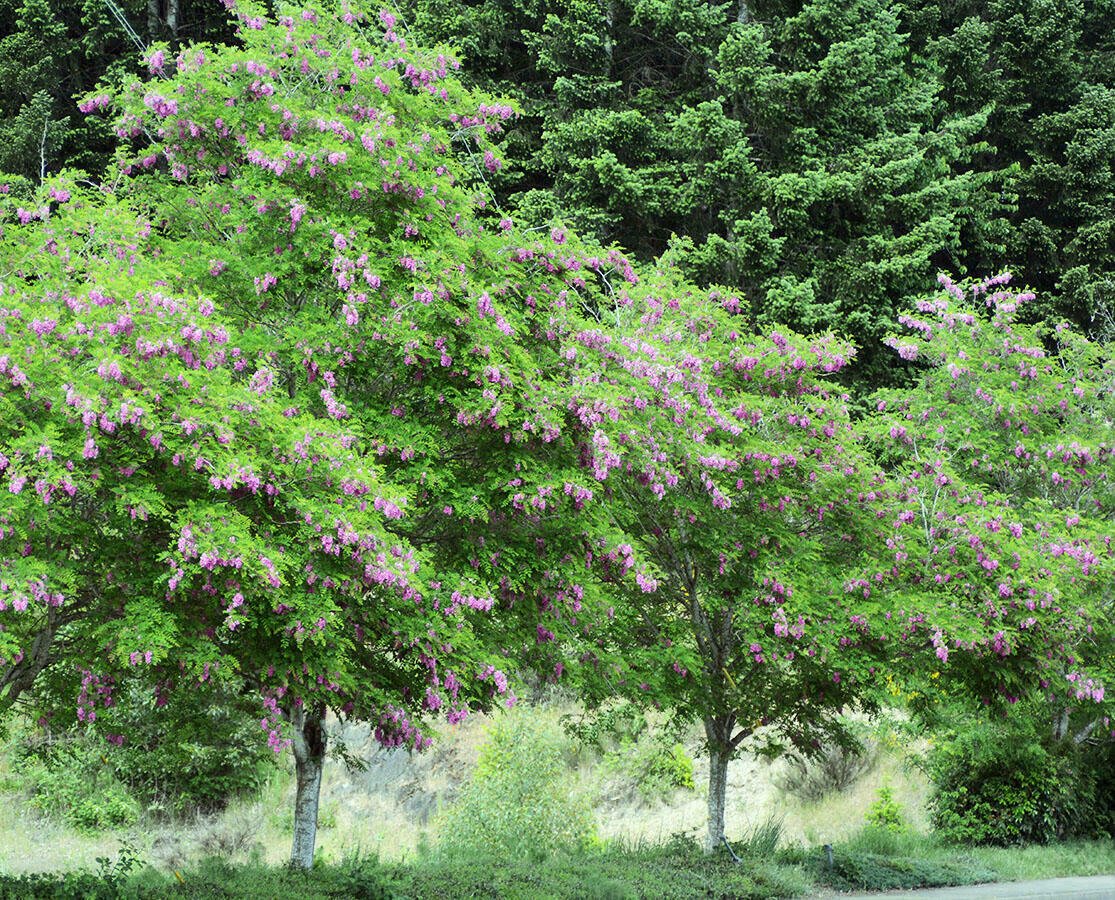
A promising tree, suitable for a variety of situations. In this blog, you'll find more details about its origin, preferred growing conditions, and potential uses.
Features
Robinia ‘Purple Robe’ was developed by William Silva in 1964 through a cross between R. ambigua ‘Decaisneana’ and R. hispida ‘Monument’. These two species are characterized by a more compact growth habit than the Common Acacia or False Acacia (R. pseudoacacia). This is also evident in Robinia ‘Purple Robe’.
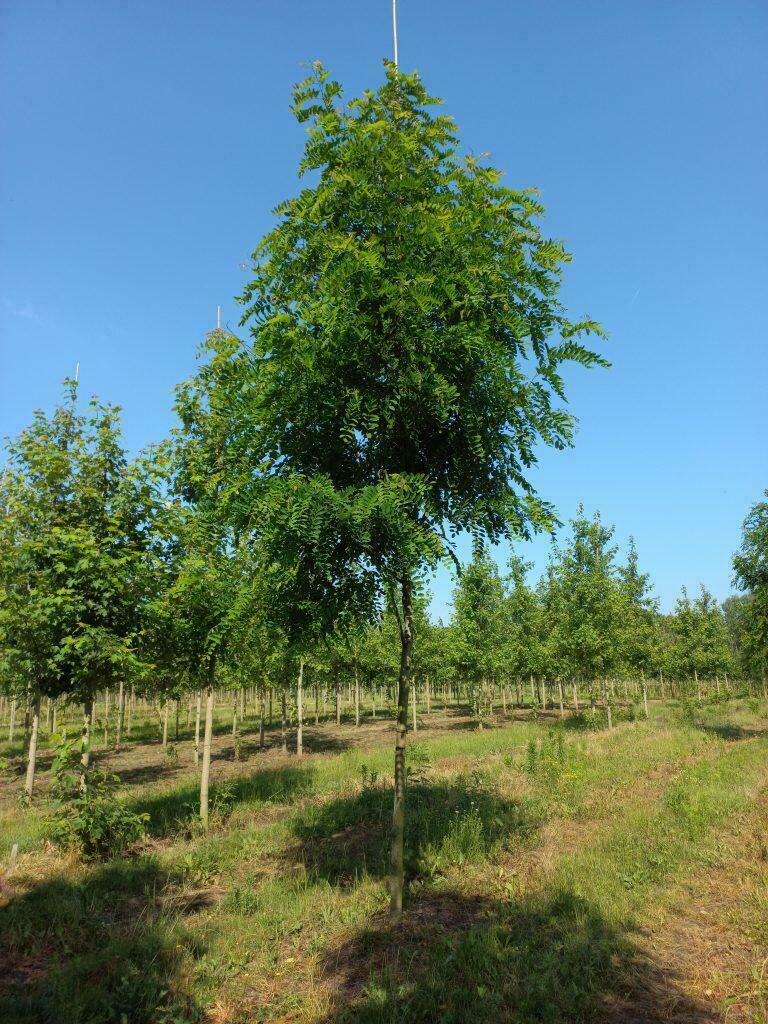
Robinia ‘Purple Robe’ is a fast-growing tree, but with a height ranging from 9 to 15 meters, it remains smaller than the false acacia.
The leaves appear a little later in the spring and are initially bronze-green in color. For the rest of the season, the leaves are a deep green—another trait it has inherited from its
ancestors. In the fall, the leaves turn a somewhat paler shade of yellow.
The compound leaves create a semi-transparent canopy, which allows for undergrowth. The fairly vertical branch structure results in an upright, rounded canopy. The canopies of older specimens have an irregular
character.
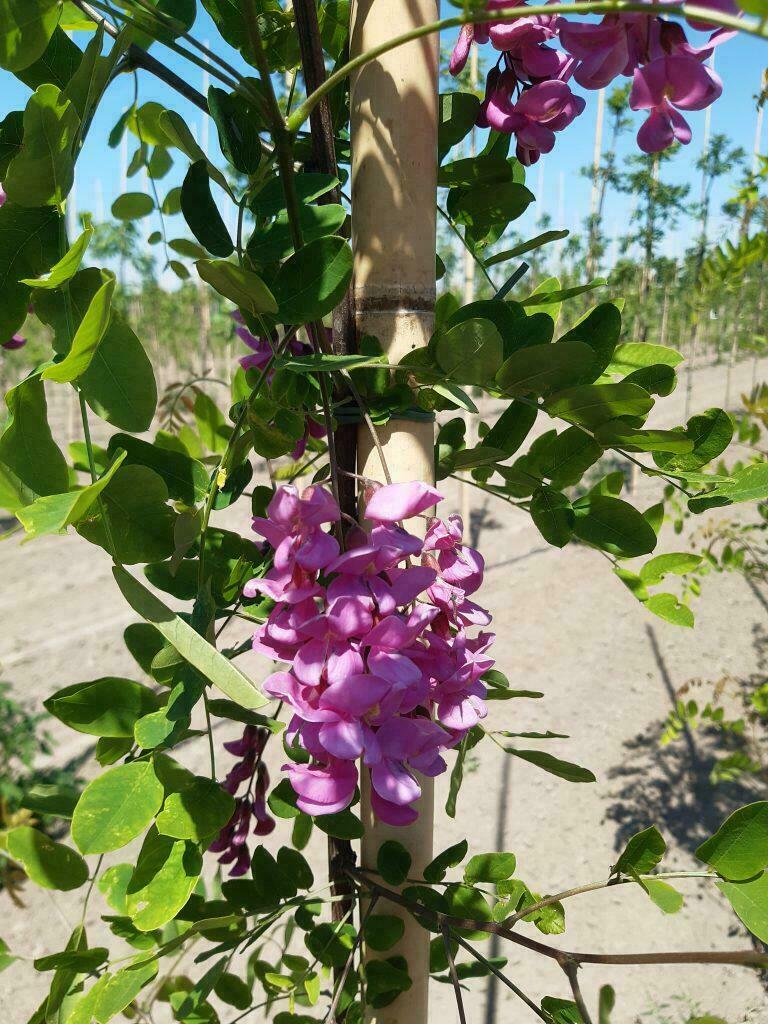
In late spring, Robinia ‘Purple Robe’ blooms with fragrant, hanging clusters of purple-pink flowers up to 20 centimeters long. These are very popular with bees thanks to their high nectar production. A valuable nectar plant that blooms after the massive April/May bloom.
Habitat
In terms of soil type, this ‘Purple Robe’ isn’t very demanding, though it does prefer loamy, moist, well-drained soil.
A location in full sun or partial shade is suitable.
This cultivar tolerates dry conditions—as well as temporary wet conditions—extremely well. Standing water, on the other hand, should be avoided. Robinia ‘Purple Robe’ grows best in wide green belts or parks.
In dense, compacted soil, the roots can push up the pavement. Air pollution and moderate winds are not a problem for this tree.

Application
A Pioneer for Poor Soils
Robinia is a tree in the legume family. Trees and plants in this family can absorb nitrogen from the air through their leaves and store it in nitrogen-fixing root nodules. This allows the tree to grow even in poor
thrives in various soils. This pioneer species is well-suited for use in the early stages of a food forest. Thanks to its vigor and nitrogen-fixing properties, this species provides shade for the developing shrub and herb layers. The leaves are
It is ideal for use as mulch to improve the soil.
Wadis
Due to its drought tolerance and ability to tolerate temporary waterlogging, this species is well-suited for use in urban areas and near wadis. We do not recommend planting it at the bottom of a wadi. The likelihood
The area of standing water at that growing site is too large.
Green belts and semi-paved areas
Robinia ‘Purple Robe’ tends to produce root suckers. This is a common response of this species, especially when the roots are damaged. We therefore recommend planting this species in wide
green belts or parks. Semi-paved areas are also an option. Planting sites near underground utility lines are less suitable, as there is a high risk that the roots will be damaged during construction work.
In the city
In cities, trees often grow under more extreme conditions. Deep shade cast by tall buildings, as well as summer heat and drought, place greater demands on the tree. Robinia ‘Purple Robe’ tolerates these conditions. Its upright branch structure makes the crown suitable for street profiles, allowing traffic to pass underneath with ease. Its open canopy and blooms enhance the street scene without making the street feel narrower or darker.
Interested?
After reading this blog, are you interested in using Robinia ‘Purple Robe’ in one of your landscaping projects? Please contact one of our account managers to inquire about availability. We currently have various sizes and grades growing in our nursery.